

Many people see life insurance only as protection for the family if they pass away. That is true, but some types of permanent life insurance in the U.S. can also build value over time. One of them is IUL (Indexed Universal Life).
In this article, I explain in simple terms how an IUL works, its benefits, the things to watch, and who it may make sense for.
What Is an IUL?
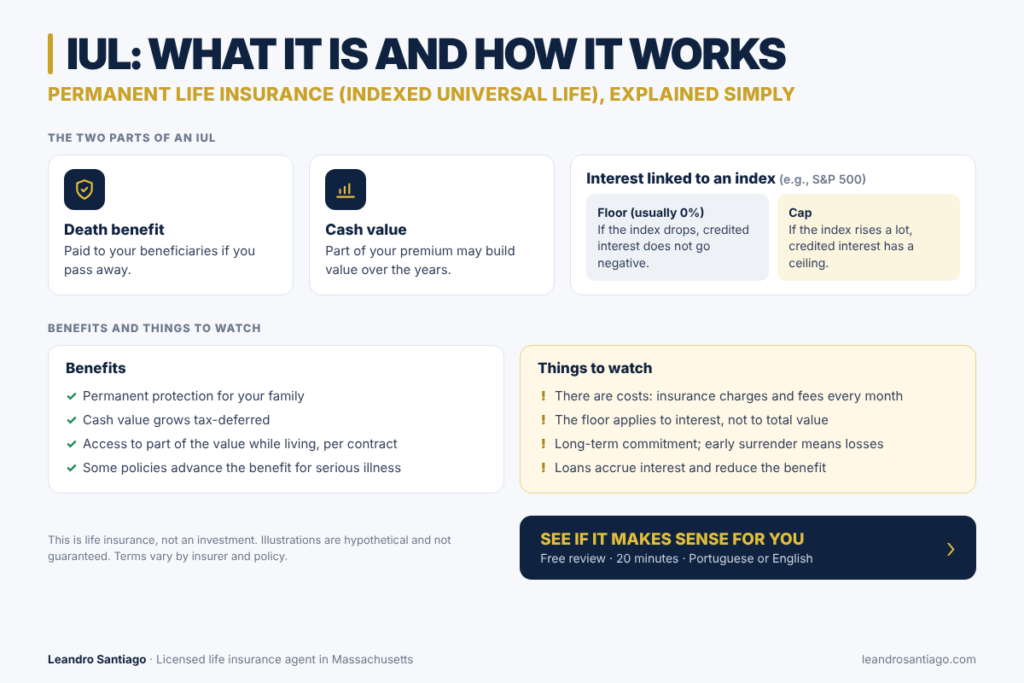
An IUL is a permanent life insurance policy. It has two parts:
- Death benefit: the amount the insurance company pays your beneficiaries if you pass away.
- Cash value: part of what you pay may build value inside the policy over the years.
The cash value receives interest that partly follows the performance of a market index, such as the S&P 500. Your money is not invested directly in the stock market. The index is only used as a reference to calculate the interest credited.
How the Interest Credit Works
Two rules matter:
- Floor: in general, if the index goes down, the interest credited for that period does not go negative. It is usually 0%.
- Cap: if the index goes up a lot, the interest credited has a ceiling. In other words, you do not receive all of the market’s gains.
Important: the floor applies to the interest credited, not to the policy’s total value. The policy has costs, such as the cost of insurance and administrative fees, which continue to be charged every month. In years with low or zero interest credited, the cash value can go down. Caps and fees can change over time, according to the policy terms.
Benefits
- Protection for your family: the death benefit is paid directly to your beneficiaries, generally free of federal income tax for them and without going through Probate.
- Tax-deferred growth: the cash value generally grows without being taxed while it stays inside the policy.
- Access to value while living: in general, you can access part of the cash value through withdrawals or policy loans, according to the contract rules.
- Living benefits: some policies let you access part of the benefit early in case of a critical, chronic or terminal illness.
Things to Watch
- It is a long-term commitment. An IUL usually makes sense for people who can keep up with payments for many years. Canceling early can mean surrender charges and losses.
- It has costs. Part of what you pay goes to the cost of insurance and fees.
- Projections are not guarantees. Illustrations show hypothetical scenarios. Actual results may differ.
- Loans have rules. Policy loans accrue interest and reduce the death benefit. If the policy is canceled or lapses with a loan outstanding, taxes may apply.
- It is not an investment. It is life insurance. For investment and tax questions, also talk to professionals in those areas.
Who May an IUL Make Sense For?
- Families who want permanent protection for the people who depend on them.
- Self-employed people and business owners who do not have a company 401(k) and want protection that can also build value over time.
- People who already have an emergency fund and can keep up with a monthly payment for many years.
For people who need protection at the lowest possible cost for a set period, term life insurance may make more sense. Every situation is different.
The Next Step
Whether an IUL makes sense for you depends on your age, health, income, goals, and how much you can pay each month. In the free review, I explain your options, show you the costs, and what is guaranteed and what is not.
Click here to schedule your free review, a 20-minute conversation.
Prefer to talk on WhatsApp? Message me here.
This content is for educational purposes only and does not replace an individual review. An IUL is life insurance, not an investment. Illustrated values are hypothetical and not guaranteed. Caps, fees, and terms vary by insurance company and policy. Tax questions should be reviewed with a tax professional.
Updated: October 2026